Less than a year after Vietnam and the United States officially upgraded their relationship to a Comprehensive Strategic Partnership (September 2023–August 2024)—the highest level of diplomacy reserved for especially trusted partners—a contrasting picture appears to be emerging behind the scenes.
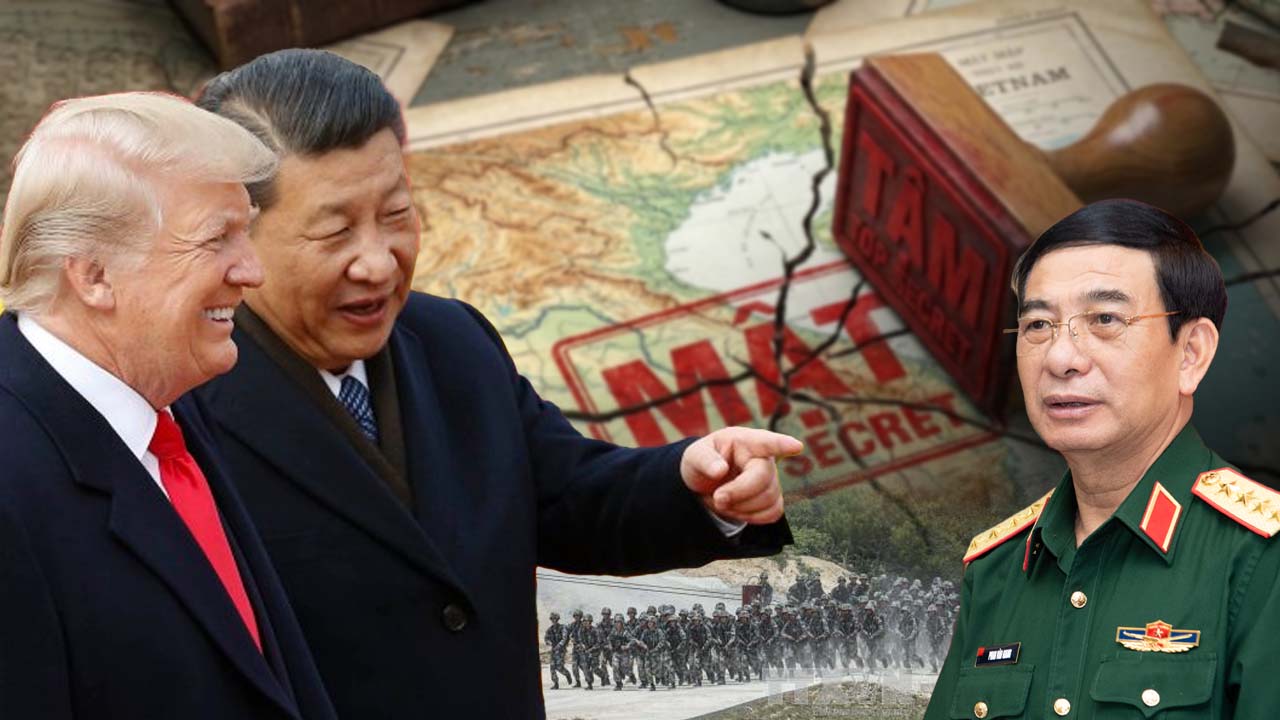
Publicly, the Vietnamese state has consistently praised mutual respect and friendship between Vietnam and the United States. Yet within the Vietnamese military, a “countering the U.S.” scenario is reportedly still being prepared.
International media have recently disclosed a leaked internal document titled “America’s Plan to Invade Vietnam for the Second Time,” reportedly completed in August 2024.
The incident has “shocked” international observers, highlighting what they describe as Hanoi’s double-faced posture toward Washington. It suggests that for Vietnam’s leadership, the United States is not a strategic partner in the true sense, but rather an existential threat to the survival of the Communist Party of Vietnam.
This fear is not merely the view of a radical faction within the Party; it is portrayed as a deep consensus across Vietnam’s leadership apparatus over many decades. In this view, the United States remains an aggressive great power.
Washington, the argument goes, is willing to employ forms of “peaceful evolution” and to intervene in Vietnam through civil society organizations in order to push Hanoi “off its trajectory,” a trajectory said to be heavily shaped by China’s influence.
A recurring obsession among Vietnam’s leadership is the prospect of a “color revolution” incited by the United States—mobilizing the public to rise up and overthrow the government, similar to “color revolutions” seen in the past.
From Hanoi’s perspective, the democratic and human-rights values promoted by Washington are portrayed merely as sophisticated tools of “peaceful evolution,” aimed at gradually transforming the nature of Vietnam’s socialist system.
One notable detail in the strategic thinking attributed to Vietnam’s military leadership is how they view the two superpowers, China and the United States.
Although Vietnam and China have intense sovereignty disputes in the South China Sea, Beijing has never been regarded as an existential threat to the Communist Party. By contrast, the United States—Vietnam’s largest export market and one of its most important economic partners—is still seen as an actor capable of, and willing to, alter the political reality in Ba Đình.
This internal tension has surfaced repeatedly in public discourse, notably in accusations aired by the military-run television network targeting Fulbright University Vietnam, portraying it as a “nest” that stokes color-revolution agitation and linking it to a “pro-U.S.” inclination associated with Tô Lâm.
Conservative forces within the Party, closely aligned with the military faction, remain an unabashedly “anti-U.S.” presence. Vietnam’s military has never truly been comfortable with Tô Lâm moving too close to Washington.
Therefore, under the leadership of General Secretary Tô Lâm—described here as holding absolute power after the 14th Party Congress—Vietnam–U.S. relations appear to be entering a new chapter that is more pragmatic, yet also more unstable.
U.S. actions in the Western Hemisphere—such as the arrest of Venezuelan President Nicolás Maduro or growing pressure on Cuba—are said to reinforce the suspicions of conservatives within the Party.
As a result, the scenario of a “second invasion” by the United States may sound like paranoia to Western audiences, but to the military faction’s planning apparatus it is treated as a serious defense plan.
This, the argument concludes, is why Tô Lâm, once seen as a reform-minded leader sympathetic to the West, has been compelled to steer Vietnam back onto China’s orbit of influence.
This absence of strategic trust within the Ba Đình leadership, it says, will continue to be a barrier preventing Vietnam from becoming a genuine U.S. ally in any anti-China coalition.
Tra My – Thoibao.de