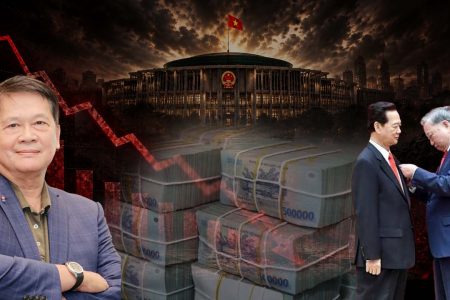
The shocking revelations from the “Report of the State Audit Office to Prime Minister Le Minh Hung” have recently sent shockwaves through public opinion and political circles.
Specifically, the budget has allocated more than 163,400 tỷ (approximately 6.3 billion USD) for officials retiring under Decree 178 as part of the policy to streamline the bureaucracy and encourage early retirement.
According to a report by the Ministry of Home Affairs, approximately 146,800 people nationwide received retirement decisions, of whom 71,610 benefited from early retirement policies and 75,229 received severance benefits.
It is reported that, in the spirit of “Focus on progress, not setbacks”—a principle initiated by General Secretary To Lam—the initial version of the streamlining policy was signed and issued by Deputy Prime Minister Nguyen Hoa Binh. Accordingly, the public administrative apparatus will be downsized, with plans to facilitate early retirement for approximately 100,000 people over a five-year period.
To encourage officials to voluntarily apply for early retirement, the government has introduced a “particularly attractive” support package. Specifically, it allows for early retirement—from 6 months to 5 years before the standard retirement age—with severance pay ranging from 12 to 60 months’ salary, plus an additional 1.5 months’ salary for each year of service.
At the same time, the program provides financial assistance to help retirees find new employment, and most importantly, allows them to immediately receive their monthly pension without any deductions.
However, the actual situation has far exceeded expectations; contrary to the planned timeline, the number of applications for early retirement has exploded beyond control. In just three months, the number of applicants far exceeded the projected 100,000—a figure originally anticipated over a five-year period.
This situation forced the government to issue an emergency decision to suspend the acceptance of applications effective August 31, 2025.
According to experts, this “collapse” stems from the government’s miscalculation, as it prioritized financial incentives while failing to establish a rigorous screening mechanism from the outset.
Consequently, the preferential budget package—originally intended to support surplus civil servants in leaving the public administration system—has instead become a “tempting opportunity” for those who are savvy.
According to the State Audit Office, many officials who had “performed their duties well” for three consecutive years—and even received the title of “Model Worker”—suddenly volunteered to be classified as “underperforming” in order to retire early.
In fact, quite a few have proactively paid bribes to “manipulate their files” in order to retire early, pocket the “compensation package”—worth anywhere from hundreds of millions to several billion dong—and then find new jobs or simply enjoy a life of leisure.
Meanwhile, competent staff who do not engage in fraud are forced to remain and shoulder the burden left by those who have retired, without any increase in income—creating injustice and completely eroding motivation within the system.
It doesn’t stop there; a series of blatant schemes to circumvent the law in order to “have it both ways” have also been exposed. Specifically:
In Hanoi, auditors discovered 16 cases where individuals, despite having received retirement approval, continued to receive both their regular salary as if they were still working and money from their severance package in the following months.
Notably in Can Tho, many financially autonomous public service units—which were supposed to cover retirement benefits out of their own funds as required by regulations—instead fraudulently shifted the entire burden to the state budget, amounting to billions of dong.
Streamlining the civil service is a sound and necessary policy to reduce the burden on the state budget. However, the exposure of these fraudulent practices under Decree 178, as described above, further highlights the irresponsibility of government leadership.
Public opinion suggests that, following the “shock” of implementing Decree 178 with its major violations, people are now recalling General Secretary To Lam’s infamous remark: “Running while waiting in line”?
Nevertheless, the public is still waiting to see whether the next audit will go all the way to fully recover the embezzled funds and strictly punish those responsible.
Or will it simply stop at a level of “learning from the experience” and then be swept under the rug!?
Trà My – Thoibao.de