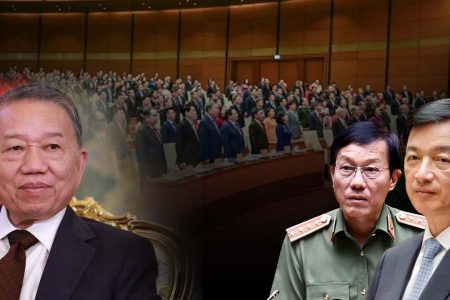
The Da Nang City Party Committee’s recent official issuance of Resolution No. 20—regarding the continued study, review, and reorganization of certain commune- and ward-level administrative units within the city—is drawing significant public attention.

In particular, the Da Nang Department of Home Affairs, along with relevant specialized agencies, is urgently drafting and soliciting feedback to finalize a proposal aimed at optimizing land area, population size, and expanding new development space.
This issue has once again sparked heated debates regarding the actual effectiveness of Minister To Lam’s nationwide campaign to streamline and merge the administrative system.
According to journalist Huynh Ngoc Chen—former Editor-in-Chief of Thanh Nien newspaper—this rapid restructuring process appears to be falling into a mechanical loop.
According to him, the elimination of intermediate administrative units (at the district level) to merge communes and wards into entities that Mr. Chênh describes as “huge”—with areas and populations equivalent to those of the former districts and counties before the streamlining—is the issue.
Notably, as the administrative functions of the new communes and wards have expanded to nearly match those of the former districts and counties, the neighborhood units below them have been forced to “step up” to shoulder the overwhelming workload.
According to observers, to date, the original four-tier government model—comprising the central government, provinces/cities, districts/counties, and communes/wards—has, despite being streamlined to three tiers, ultimately “mutated” into a new four-tier structure: the central government, provinces/cities, communes/wards, and neighborhood units.
Still according to Mr. Chênh, the nature of operations and the form of governance have seen virtually no fundamental changes, creating a deeply skeptical sense among people that “it’s just the same old story.”
Moreover, the wave of rapid mergers has led to the loss of significant cultural and economic heritage, as many district-level cities—which were once famous national heritage sites and scenic spots, such as Hoi An, Nha Trang, Bien Hoa, Da Lat, Vinh, Phu Ly, Sa Pa, and Son Tay—have been divided or dissolved and transformed into ward-level units.
The loss of these historic city designations is eroding local identity and causing profound psychological disruption among local communities.
According to experts, the core issue of this reform effort lies in the discrepancy between theoretical objectives and the practical pressures currently at play.
The initial policy—merging to reduce staff and cut administrative layers—was entirely sound; however, when the geographic size and population of a local administrative unit exceed manageable thresholds, the system immediately becomes overburdened.
To maintain management and operations, local authorities have no choice but to redistribute responsibilities to lower-level administrative units.
This mandatory adjustment inadvertently recreates the original cumbersome structure, albeit under a different name.
This is precisely why General Secretary and President To Lam, in his recent guidance, acknowledged that streamlining the administrative apparatus is an extremely complex task fraught with unforeseeable challenges.
Most recently, Minister of Home Affairs Nguyen Tien Hai stated that the Ministry of Home Affairs has delegated authority to provinces and cities to proactively review and propose the merger or division of communes and wards based on local realities.
This demonstrates that the challenge of administrative reform in Vietnam cannot be reduced to mere calculations of boundary adjustments on a map or mechanical cuts in numbers, as General Secretary To Lam had previously envisioned.
Any change to the governance model at the national level requires meticulous and scientific planning. Without thorough consideration, reform efforts can easily turn into an extremely costly exercise that yields nothing more than superficial changes in terminology.
Tra My – Thoibao.de
=======
To Lam’s Administrative Reform and Merger: Why Is It “Same Old, Same Old”?
“… Merging wards and communes into units that are too large causes overload, forcing the government to elevate the status of neighborhood units, inadvertently creating a more cumbersome bureaucracy under a new name.”
#Vietnam #ChinhTruongVN #Thoibao